Key Considerations for Developing a Telemedicine Application for the US

Key Considerations for Developing a Customized Telemedicine App

Telemedicine is a blessing for the modern world. It opens up opportunities that we did not have. With it, patients have remote access to healthcare services. They can have remote doctor visits and get diagnoses and treatment plans. 

Telemedicine is famous for patients since the pandemic. It was popular in the US too. With this technology, patients could stay in the safety of their homes and get healthcare services. 

Its traction will increase in the coming years as well. Healthcare providers need to prepare for the future. They should understand everything that goes into making such an app.  

Our experts have listed the key points for developing a customized Telemedicine app. Save this list to make sure your app stands out from your competitors.

1. Keeping the Telemedicine App User-Friendly

User interface design is what a patient sees when using your app. This interface must be simple, intuitive, and user-friendly. Only then can a patient find what they are looking for. Navigation is important for retention as well. 

It should have an optimized interface design for different devices. This way patients can use the app from smartphones, tablets, and desktops. A well-designed app encourages patients to use the app. The result is better patient engagement and improved health outcomes. 

2. Ensuring the Essential Feature Set of Telemedicine

Creating a custom telemedicine app requires choosing its features. The must-haves are video calls and messaging. Other facilities include appointment booking, and managing patient records. There should be the option to customize features for different medical fields. Customization lets healthcare providers adapt the app to their specialty. 

3. Hiring Experienced Telemedicine App Developers 

Building a top-notch telemedicine app does not happen overnight. It is the hard work of experts. You must hire experienced telemedicine app developers. They know the ins and outs of app development. Their experience can make sure it’s trustworthy, safe, and easy to use. 

A good app should be able to integrate with other healthcare systems. Always choose a team with a good history in custom telemedicine app development. This can save you time and money. 

4. Managing Costs and Timeline for Development

Developing a telemedicine app involves significant costs. Without careful thought, it can end up in losses. Careful management of the budget and timeline is essential. The budget should include development expenses, platform fees, framework costs, and ongoing maintenance. 

A budget allows healthcare providers to understand the financial implications and plan accordingly. Setting up a clear development timeline helps ensure the project stays on track and within budget. Consider all the costs before you get down to developing. This way you can ensure your investment pays off. 

5. Seamless Integration with Third-Party Systems

For custom telemedicine apps, connecting with other systems is vital.  Developers do this by integrating APIs. It can communicate and coordinate with other essential services. eg:  With API integrations, you get all that you need in one interface. Some of the common integrations are:

The developer you choose has to be an expert in API integration. This will give you peace of mind regarding privacy and security. A smooth API integration means that your app works smoothly.

6. Prioritizing Data Security and Privacy

A customized telemedicine app deals with a lot of information. This is sensitive information. Handling and storing them come under legal scrutiny. In the US there are regulations like the HIPAA. It ensures that patient data are private and safe. 

The app has to comply with the regulations of the region. This will help prevent unauthorized access or leak of data. The app should be well protected with necessary security measures. Some of them are 

  • end-to-end encryption
  • regular security audits
  • secure user authentication

7. Healthcare Regulatory and Security Compliance

As discussed above, regulatory bodies have strict rules to bind medical practices. Here are some aspects, eg: Medical malpractice, privacy, billing and coding, and prescription drug regulation.

These strict measures promote transparency and accountability. HIPAA is one such regulation enforced in the United States. Other countries have different compliance such as PDP, PIPEDA, GDPR, and HL7/FHIR. Here is the healthcare regulatory compliance to follow while developing an application. All of these are in place to promote ethics in the industry.

8. Custom Telemedicine App Development for Specialty Care

Every area of medical/healthcare is different. The kind of healthcare app development services provided varies from one to the other. The apps that cater to this department are bound to be different. Telemedicine app development services should be flexible. They should be able to create custom apps for these different departments. 

A telemedicine app development company is building an app for mental health, neurology, and more. The interface for each of these areas would be different. The mental health app would have mood trackers, virtual therapy sessions, etc. The pediatrics app would have vaccination schedules and growth trackers. 

 9. Uninterrupted Care Delivery with Telemedicine

Uninterrupted care is vital for app users. Having 24/7 customer support is a must for healthcare providers and patients. If there’s a technical problem or any issue, support is required. Choose the telemedicine app development company that provides 24/7 SLA support. 

With round-the-clock support, they can give support at all times. This ensures continuous care. This reduces the chances of treatment interruptions and keeps patients happy. Efficient support lets healthcare providers catch and fix problems early. This way you can prevent bigger issues down the road.

10. Enhancing User Experience with Additional Features

Including the main features, custom Telemedicine apps can have extra features like push notifications and chatbots. They give users quick and easy access to information. Automated appointment reminders decrease no-shows and keep patients engaged. They may be designed to make the user experience better. These are what sets an ordinary app from a good one. Multi-language support feature helps reach a diverse patient group. 

Having these features makes the app more appealing to both parties. It’s a great way to improve the experience and satisfaction of users.

Summing Up 

The concept of Telemedicine is growing. It is making healthcare easy to access and affordable. But it takes a lot of work and effort to make it happen. It takes the well-thought-out planning of a provider and the skill of a developer. If skill, planning, and implementation come in the right proportion, it makes a great app.

Are you looking for custom telemedicine app development services? EMed HealthTech will be the best choice. Make sure you keep all of the above tips in mind. 

By prioritizing these factors, healthcare providers can create great apps. These apps can deliver patients safe, effective, and personalized care.

At EMed HealthTech, we understand the challenges in delivering virtual services. And we explained, how to get the benefits of Telemedicine in Virtual care. That’s why we offer custom telemedicine app development services that cater to different needs. 

We have a team of expert developers having vast experience in developing telemedicine apps for a long list of clients. We ensure compliance, ease of use and provide 24/7 SLA support. 

Contact us today to learn more about customized Telemedicine application development by EMed HealthTech.  We can help you deliver the best care possible to your patients.

Implementing Telehealth Program In Your Clinic How to Make it a Success

Implementing a Telehealth Program In Your Clinic: How to Make it a Success?

Telehealth was a great relief for patients and doctors during the COVID pandemic times. The world had come to a stop. Those in need of medical attention suffered the most. 

We used technology to overcome those challenges. And since then there is no looking back.   

The worldwide telehealth market value was $87.2 billion in 2022. It’s expected to reach $285.7 billion by 2027. The telehealth market is booming. There is worldwide adoption of this tech. This is the ideal time for healthcare providers to be a part of it.

As a healthcare provider, have you adopted this tech? 

In this article, we are going to explore the Telehealth implementation process. It takes a lot of effort to implement software. We will explore the different factors that affect it. From picking the well-developed Telemedicine software, and staff training to checks, we will cover everything. Read on to find out how to implement it the right way. 

Understanding Telehealth

Before we implement a telehealth program, let us first know what telehealth is. 

Telehealth is using technology for remote healthcare. It includes features like video appointments, secure messaging, remote patient monitoring, and EHR.

  1. Real-time video calls allow healthcare providers to interact with patients. This is a virtual consultation. 
  2. Secure messaging services provide discretion and privacy between the patient and the doctor. 
  3. Remote patient monitoring enables doctors to keep track of their health. These aid in treating chronic conditions. 
  4. EHR or electronic health records integration allows access to patient information. This enables coordinated care.

These are at the core of the concept of telehealth. 

The smart way to go is to choose a custom telemedicine software development company. You can add features that enhance your medical service. 

Some additional features of Telemedicine you can add are: 

  1. Mobile Apps for convenient access.
  2. Appointment scheduling and reminders for efficient time management.
  3. Prescription management for electronic prescribing.
  4. Shared tools like whiteboards for real-time contact.
  5. Multilingual support for overcoming language barriers.
  6. Remote access to diagnostic data for proactive care management.
  7. Recording for filing and quality assurance.

These features add more value to the software. It also improves the overall quality of care given. 

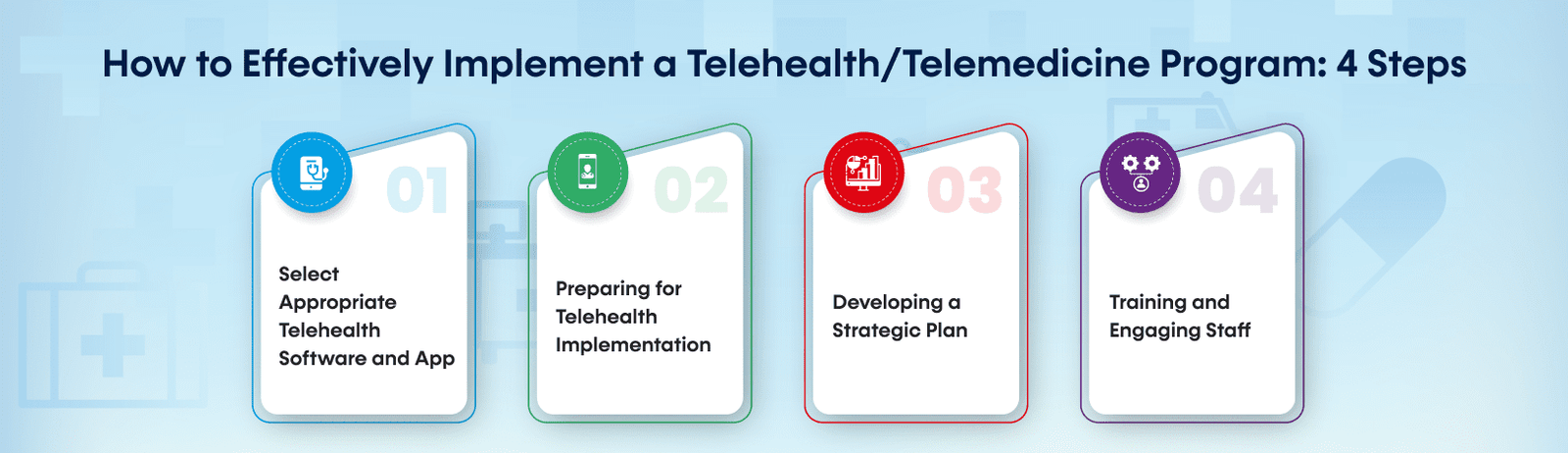
How to Effectively Implement a Telehealth Program? 4 Steps

A telehealth program has become vital for medical practice. It offers many benefits for healthcare providers. To successfully implement, there needs to be careful planning and execution. 

Here is a quick guide on implementing a telehealth program. We are sharing some insights and strategies for healthcare professionals.

How to Effectively Implement a Telehealth Program in clinic

1. Select Appropriate Telehealth Software and App

The first step is to pick the right software. It is a booming market, you will find yourself spoiled for choice. It is going to be a confusing period. 

Take a good look at the different options you have. Talk in detail to different vendors to get an idea of the market price. 

Here is an easy checklist of the steps in selecting telehealth software and apps. 

—Evaluate your clinic’s needs

Before choosing the right telehealth software and app, evaluate your specific needs. Consider factors such as the size of your practice and the number of healthcare providers. 

Think about the different features you want to add. 

—Research available telehealth software and app options

Look for reputable vendors or providers. They should have a proven healthcare industry track record. 

Consider factors such as the software’s compatibility with your existing systems. The app offered should have a user-friendly interface. It should meet regulatory requirements and security standards. 

—Conduct demos and trials

Conduct demos and trials to make the right choice. Many vendors offer free trials or product demos. You can experience the software firsthand before choosing it. 

2. Preparing for Telehealth Implementation

Let’s look at some prep steps to help you implement telehealth software. Let’s make sure everything is set before we begin.  

—Assessing Clinic Readiness

Before applying the telehealth software, evaluate your clinic’s readiness. Assess the infrastructure, technology requirements, and staff skills. Check the network and equipment quality. Make upgrades wherever necessary. 

Now that the equipment is taken care of, let’s talk about the staff. The staff has to be ready too. How equipped are they to use new software is important? Identify skill gaps and develop a training plan.

—Laws and Regulations

Before launching a telehealth program, take into account the legalities. Make sure you understand all laws and regulations. Identify the regulations and make sure the software complies with them. Ensure you have the framework to comply. 

Be aware of applicable privacy regulations like HIPAA. Opt for HIPAA-compliant telemedicine platforms. They come with robust security features.

3. Developing a Strategic Plan

Developing a well-thought-out strategic plan is a necessity. Only then can you apply the software correctly? This plan will serve as a roadmap to guide your telehealth initiatives. 

—Define clear goals

Identify what you want to achieve with telehealth. Nowadays, Patient-centric care becomes an innovative and required approach in healthcare due to various reasons. Develop software that improves patient access and satisfaction and a can better medium to contact patients. 

—Set measurable targets 

Establish specific benchmarks to track progress and success.

—Focus on target patients

Consider who will benefit most from telehealth. Those who are chronically ill? Or those in remote areas? 

—Integrate with suitable specialties

Choose where you want to apply this tech. Is it best for one department or the other? 

—Customize for patients

Tailor your telehealth services to your needs. It has to suit the needs of your target patient groups as well. 

—Ensuring Seamless Patient Experience

The idea is to make telehealth a great experience for patients. You have to focus on tips to increase satisfaction, engagement, etc. 

Educate patients about telemedicine benefits and processes. Make sure you provide clear instructions for platform navigation. Use educational resources to highlight advantages.

Offer dedicated support and clear instructions for common issues. Provide online resources, like tutorials and FAQs, for self-help.

Create intuitive interfaces for patient portals and apps. It should have clear navigation. Make sure to include essential features like booking, consulting, etc. 

4. Training and Engaging Staff

Training and engaging your staff to adapt the software. It is an essential part of a successful implementation. This training should empower your staff to use the software without any issues. 

  1. Teach software navigation, virtual consultations, and troubleshooting. 
  2. Foster open dialogue and support. 
  3. Establish clear communication channels for collaboration.
  4. Share success stories and positive impacts.
  5. Provide ongoing education on telehealth advancements and best practices.
  6. Ensuring Healthcare Regulatory and Security Compliance
  7. Here are some key concerns to ensure security and compliance:
  8. Adhering to HIPAA regulations and guidelines.
  9. Conducting risk assessments 
  10. Identifying and mitigating potential vulnerabilities.
  11. Stay updated on emerging security threats 
  12. Updated on technological advancements.
  13. Evaluating and Enhancing Telehealth Program Performance

This is an important step to ensure long-term success. It will also impact care delivery. 

Collect and analyze key performance indicators (KPIs). These can include metrics such as the number of telehealth visits, and patient wait times.. You can understand things like provider satisfaction from it. 

Gather patient feedback and satisfaction ratings through surveys. This will give valuable insights into program effectiveness. 

Identify areas for improvement and make necessary adjustments. 

Summing Up 

The world is zooming into the realm of technology. It is making human lives more convenient. Make sure your healthcare facility is in the game. A telehealth program can be a major update for your firm. But what matters more is to apply it the right way. 

This article has traced the path to implementing the software. Every company is unique and there is no wrong way to do it. But getting the fundamentals right is important. 

Now that you have a clear idea of how to do it. All you need to do is get started on your software. 

EMed HealthTech is a leading healthcare software solutions provider

We are experts at creating custom solutions. We tailor our software to meet your needs.

Talk to us about your clinic’s unique requirements. We will find solutions that suit just that. 

Get in touch with us today to learn more!

Dec 2022 Doctor On Demand App Development The Future of the Healthcare Industry

How Will Doctor On-Demand Apps Revolutionize the Healthcare Industry?

There are amazing ways in which technology has seeped into our daily lives to make them more convenient. One such way is how we perceive healthcare today. Get prescriptions without hospital visits and medicines without pharmacy visits, and keep better track of your illnesses without leaving your home. All of this is possible thanks to technology.

One such way we are benefited from technology is the doctor-on-demand app. It is increasingly popular with features that let you call a doctor on demand and get the medical advice you want. If you are a doctor or healthcare provider who wishes to enter this market segment, this article talks about what a doctor on-demand app development is and how it will help to revolutionize the healthcare industry.

Doctor On-Demand Apps: What are They and Why are they So Popular?

A doctor on-demand app is an app that facilitates virtual consultations with doctors via video conferencing. It can be done from anywhere, even at home, as all it takes is a stable internet connection and the doctor’s availability. Doctor-on-demand apps are becoming virally popular due to many reasons.

Advantages for patients

Advantages-for-patients

– Remote access: Seeing a doctor when one is not well is not a pleasant experience. Especially if the doctor in concern is in a far-off city. With a doctor on-demand app, this is made possible.

– Affordable services: With a doctor’s on-demand app, there is no need to travel distances, waste time in queues, and take leaves at work, leading to lower expenses.

– Better medical adherence: With better and regular follow-ups and easier interaction with medical professionals, the outcomes of the treatments are also better.

– Less paperwork: With appointments and registration all made online, there is very little paperwork involved, only electronic records.

Advantages for Practitioners

Advantages-for-Practitioners

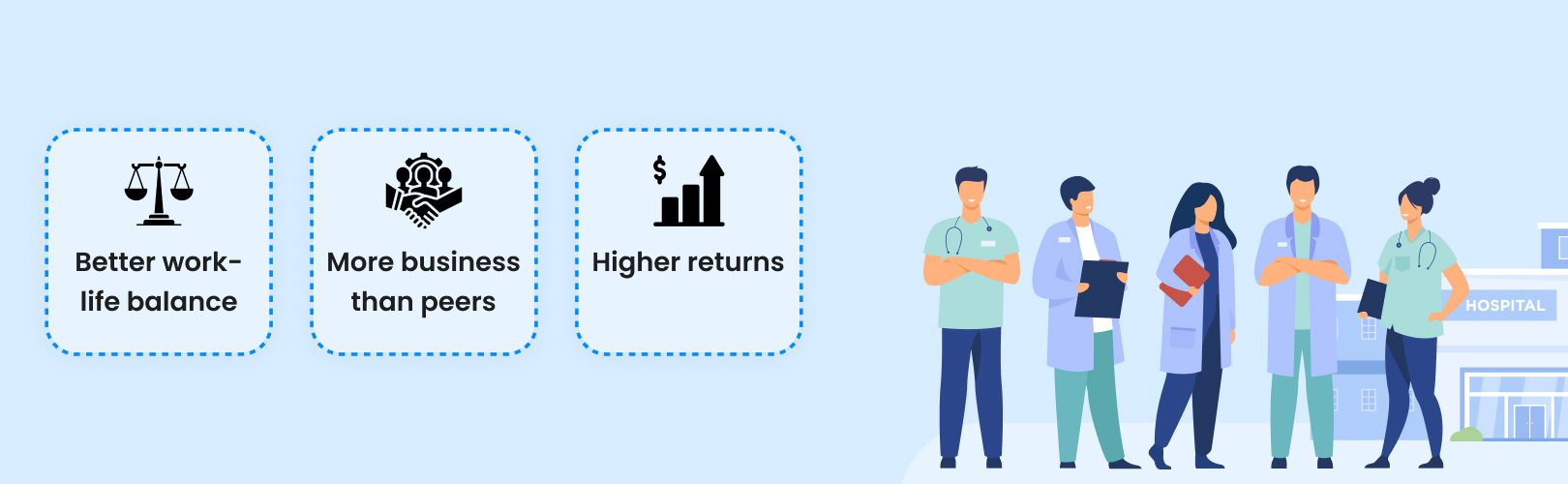
– Better work-life balance: Doctors can have better access to their work without having to travel distances between the offices and patients’ homes.

– More business than peers: Cutting-edge technology like a doctor’s on-demand app is much better than traditional visits. Customers would prefer it over the hassles of going physically to a clinic, giving you an advantage in competition.

– Higher returns: with a doctor on-demand app, the expenses spent on staff, equipment, and infrastructure are considerably lower, while the inflow of patients is higher.

How Does a Doctor On-Demand App Work?

Using a doctor on-demand app is as easy as using any other app with GPS. Here is the average user journey:

  1. Download the app, set up a profile, and submit a description of illnesses and problems.
  2. Specialists related to the problems are listed from the area detected via GPS.
  3. The patient picks a doctor, the date and time from the doctor’s calendar according to availability.
  4. The consultation takes place, e-prescription is provided along with the required course of medical action.
  5. The payment is made through a secure payment portal.

Questions to Ask Yourself Before Investing in On-Demand App Development

Before creating an on-demand doctors app, there are certain things you need to ask yourself. These questions can be used as a checklist to ensure you are on the right path. Here they are:

–  Who is my target audience?
Once you know the kind of users who will be using your app, you can consider how it can fit their needs and make it more user-friendly.

–  Do I have a good network of doctors, to begin with?
You must certify doctors from different streams to be part of your telemedicine app.

–  What features should I include?
You need to be certain about the features you will include in the app. Some non-negotiable features are a camera, map, payment portal, etc.

–  What are the compliances I need to be aware of?
You must be aware of the different app integrations, certifications, and medical acts you must follow.

–  What technology stack should I use?
The kind of technology you use reflects on the end-user experience. Without the best-suited tech stack, your app cannot be smooth and easy to use.

–  What is my budget?
Without knowledge of the kind of budget you have, you cannot make viable plans.

Technologies and Tech Stack for Your Doctor On-Demand App

Let us take a quick look at the kind of tech stack required to make a doctor on-demand app.

Frontend                                          

  1. CSS
  2. Java
  3. React

Backend

  1. Laravel
  2. Node.js

Platform

  1. Android
  2. iOS
  3. Web App

Payment

  1. Paytm API
  2. PayPal API
  3. Razorpay API

Location

  1. GoogleMapsSDK (Android)

Social Login

  1. Google
  2. Facebook

SMS/Messages/Notification

  1. Twilio
  2. Push.io
  3. Batch

Database

  1. MySQL
  2. MongoDB

The different technologies used in a doctor on-demand app include:

– AI and ML: Artificial intelligence and machine learning are an integral part of apps these days to ensure better user experience

– Blockchain: Blockchain has found wide implementation in telemedicine apps to ensure the security of sensitive data as well as easy access to records

– Virtual Reality & Augmented Reality: The use of VR and VR on telemedicine apps helps make interactions more effective as doctors can better inform patients about their conditions with such technology

– 5G: With 5G, the connectivity speed becomes manifold, making the whole process more effective and seamless.

– Voice Search: with voice search, users can use their voice to make it more convenient and user-friendly.

– Third-party integration: The app can use third-party integrations for features like ERP, shipping & logistics, Chatbots, email, Payment gateways, analytics, etc.

How to Choose the Right On-Demand App Development Partner?

Making an on-demand doctor app is not easy. There are a lot of complicated things that come together to make the app possible. Finding the right developers, tech stack, designers, budget, time frame, and so much more affect the output. One way would be to do it with an in-house team. However, we focus only on an external option for obvious reasons like expenses and time.

A doctor appointment booking app development partner would ideally have the following:

– A rich experience.

– A good client list.

– Impressive portfolio.

– Willing to work within your parameters.

– Flexibility to work with your ideas.

Also, Read the Experts Tips and Tricks of Doctor Appointment Booking App by EMed HealthTech.

If you are looking for one such development team, you need not look any further.

Why Trust EMed HealthTech With Your Doctor App?

EMed HealthTech is a leading custom software development company for the healthcare industry. We have been providing comprehensive healthcare IT consultation focusing on technology, healthcare, and marketing. We empower our clients to improve customer experience and engagement. Without tech products, we ensure healthcare practitioners improve their health outcomes and increase revenue generation.

Our prestigious client list and the long list of previous projects speak volumes about our experience. Contact us today to make an appointment and start your app development journey.

FAQs About Doctor On-Demand App

1. What is a doctor on-demand app?

A doctor on-demand app provides a virtual consultation platform with doctors. Patients can now consult doctors from the comfort of their homes.

2. How much does the doctor on-demand app development cost?

The cost varies according to the app’s size and complexity it has. There is no fixed price as such

3. How to know if you should invest in a doctor on-demand app?

If you are a healthcare practitioner willing to take the leap into the technology of the future and be on the side of industry leaders, then this investment suits your journey.


Top 5 Reasons to Develop A Telemedicine App

Top 10 Reasons to Develop a Telemedicine App

The concept of telemedicine apps has been around for a long time. The COVID pandemic forced us to resort to telemedicine out of the restrictions imposed on movement. It has highlighted the need to integrate a functional telemedicine system that runs alongside regular healthcare.

Connecting patients and healthcare providers via technology are being increasingly implemented worldwide post COVID. The onset of COVID also warmed up the users to the benefits of telemedicine. Post-COVID, there has been a stark increase in the number of virtual consultations via doctor appointment booking apps. Studies show that there has been a triple increase in the investment made to telemedicine in 2020 than it had in 2017.

It is an area that has the potential to change the way we see medical care. Here is all you need to know about telemedicine, its implementation via telemedicine app, why you should invest in it, and the challenges faced in the process.

What is a Telemedicine App?

telemedicine

A telemedicine app is a software that functions as a platform to avail various healthcare services. It serves the patients to determine the nature of their ailment, find the apt healthcare provider, and provide virtual consultation, and follow-ups. It is also an avenue to cater to pharmaceutical needs, and avail services of testing and lab facilities.

Telemedicine apps also provide the platform for healthcare providers to connect to patients, organize data and schedules, manage visits, and more.

It is a holistic platform that has a wide range of functions. When developed properly, telemedicine software can create the ideal network of healthcare providers and patients. The healthcare industry is adopting this technology to enmesh its services with the needs of the day.

If COVID showed us telemedicine was indispensable, we are making a stronger case for it. Here are some very compelling reasons why you should be investing in a telemedicine app today

1. Better access to healthcare: Healthcare has often been inaccessible to people who live in rural areas. Sometimes a specialist we need is not available in a country. This challenge of distance and access is neutralized when there is a virtual set-up that enables the meeting of people from whichever corner of the world.

2. Maintain social distance: This is the first and foremost reason telemedicine was popular during the COVID pandemic. It serves the purpose later too, as contagious diseases will spread less when more and more people opt for virtual consultations.

3. Steady care for chronic health issues: Patients who battle chronic illnesses like diabetes, heart diseases, or lifestyle diseases need not travel to the doctor for every consultation. A virtual care system enables the patient to stay in the comfort of their home.

4. Reduces patient waiting time: Access to healthcare is hindered majorly by waiting time. The availability of doctors in a particular area, the number of patients seeking the same doctor, and the lack of a proper system in place contribute to the cause of the patient.

5. Lower treatment costs: The cost of the treatment is seen to be significantly lower when it comes to virtual care. This applies to both the hospital and the patient. The hospital could save up to $24 per patient and the patient saved an average of $50 in travel expenses, a study showed.

6. Gain an edge over competitors: The telemedicine system allows healthcare providers to have an advantage over their competitors who have not adopted the technology. It also gives them access to patients who would choose a remote consultation over being physically present for one.

7. Save infrastructure costs: The first advantage of a virtual care system is to be free of infrastructure costs. Compared to the hefty architectural investment required, a telemedicine app development costs significantly less. This automatically makes healthcare more affordable.

8. Balances the doctor-patient ratio: One of the biggest advantages of telemedicine is how it negates geographical barriers to bringing services to customers. While a particular place may be constrained due to the lack of doctors in proportion to patients, another place may have an abundance.

9. Access to healthcare during epidemics/disasters: Telemedicine proved to be the best option to cater to the healthcare industry during the COVID pandemic. If this proves anything, it is that telemedicine is the most effective form of providing medical service during times of such crisis.

10. The advantage of technology: A telemedicine system puts the doctor and patient in a position where they can use technology to their benefit. For example, the doctor can refer to biometric readings taken from wearable techs to monitor the health of the patient.

To know more about how to develop telemedicine apps check out this link.

Telemedicine App Development Challenges

The world of telemedicine is a sophisticated one that focuses on making accessibility easier. However, it is not one without challenges. It has its unique challenges. Here are some of them.

features-telemedicine

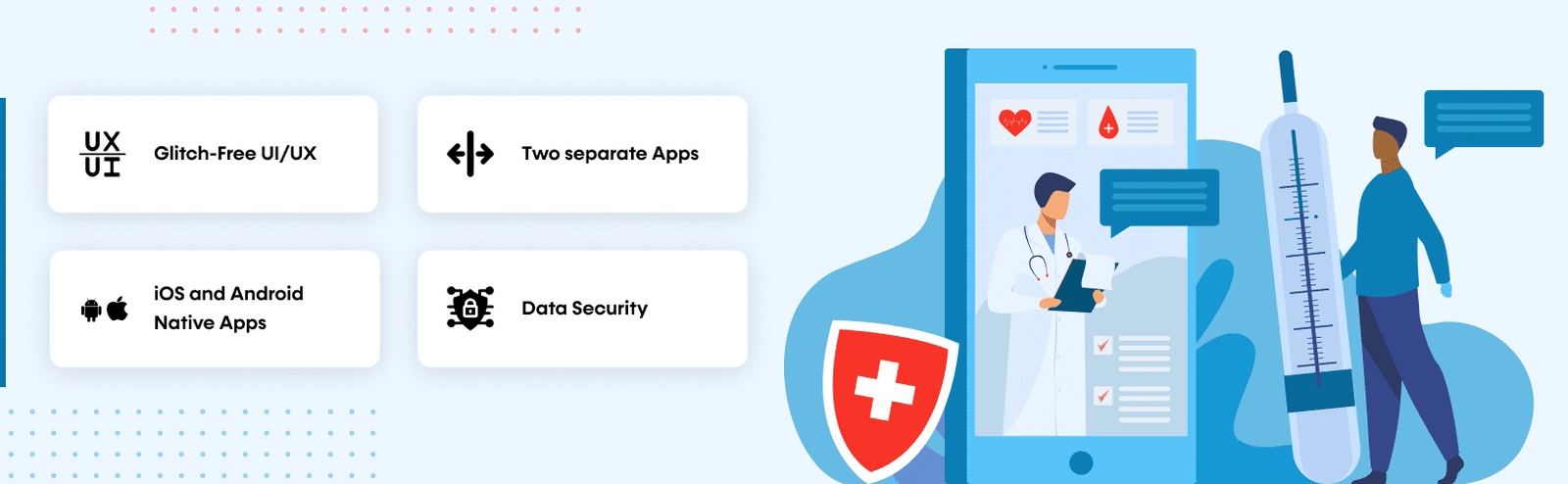
1. Glitch-free UI/UX: The healthcare industry has no room for error as it could prove even fatal. A telemedicine app has to remain glitch-free and very user-friendly. The patient and the doctor must be able to navigate the app with the least difficulty.

2. Two separate apps: A telemedicine app has two significant users – the doctors and the patients. Both users have different apps. These call for two separate fronts that are integrated seamlessly.

3. iOS and Android Native Apps: Telemedicine apps must be designed to be compatible with iOS and Android OSes. This requires a larger development team.

4. Data Security: The data shared via a telemedicine app is sensitive and confidential. It requires high-level security from being leaked by hackers.

Take Advantage of High-Quality Telemedicine App Development

Creating a telemedicine app has its benefits and small challenges. But in the end, it benefits all. It creates a world of equal access and opportunity. If you are convinced that you need to create an impeccably designed telemedicine app, look no further than EMed HealthTech.

At EMed HealthTech, we deliver quality healthcare software services and solutions to all your needs, garnering the trust of the healthcare industry. Choose EMed HealthTech for your telemedicine app development services. Reach out to us today for a custom quote.