Posted by
Hasanabbas
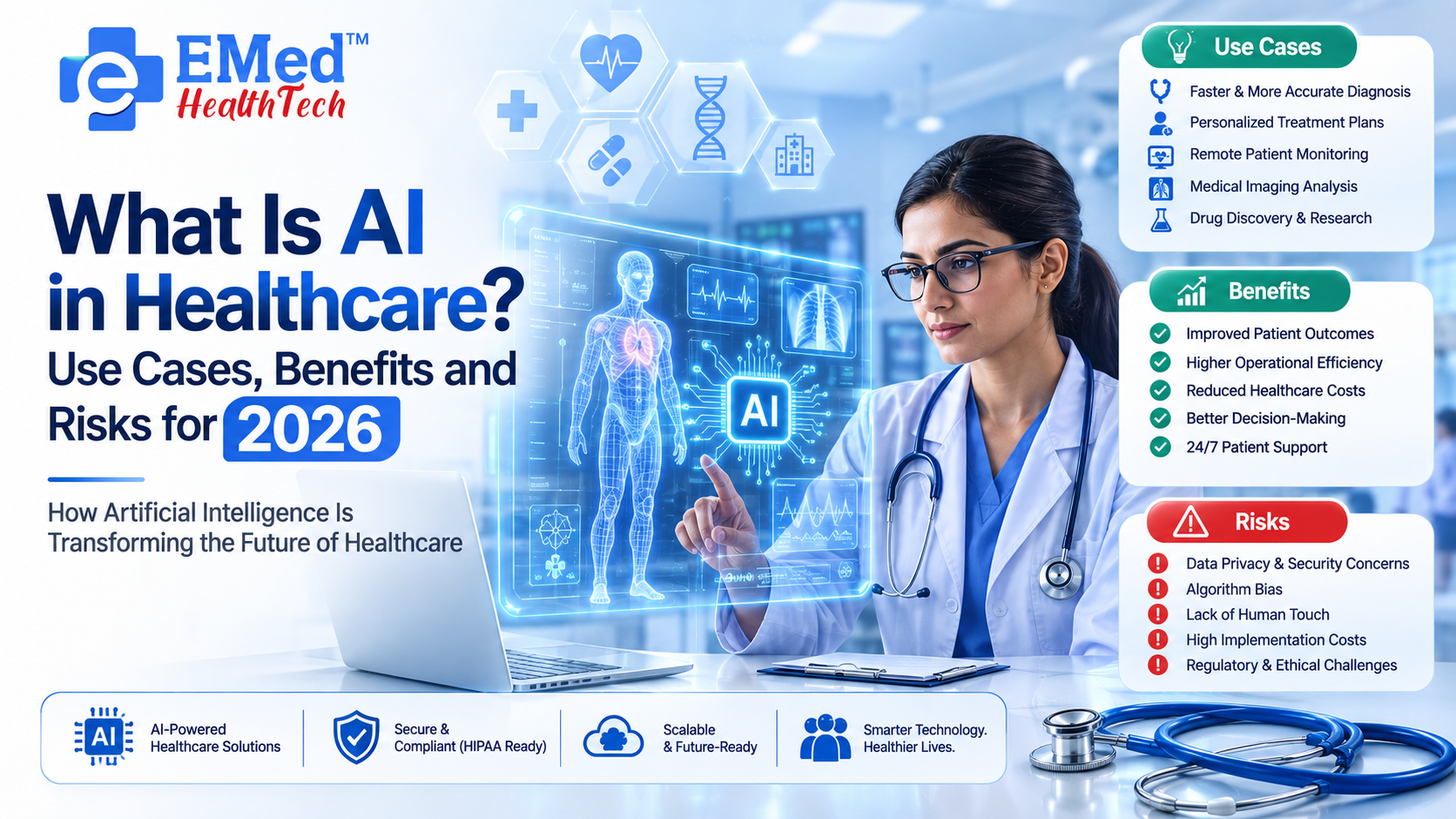 Artificial intelligence is fundamentally reshaping healthcare in 2026. From diagnostic systems that detect diseases earlier than human radiologists to administrative platforms that streamline hospital operations, AI has become the central topic in healthcare IT discussions worldwide. The healthcare industry stands at an inflection point where embracing AI technology is no longer optional but essential for organizational survival and growth.
The global healthcare AI market is expanding rapidly, driven by the urgent need to improve patient outcomes, reduce operational costs, and address the shortage of medical professionals. Healthcare providers across India and globally are investing heavily in artificial intelligence healthcare solutions to deliver better care experiences. But what exactly does this transformation entail, and what considerations should healthcare organizations keep in mind?
Artificial intelligence in healthcare refers to the application of machine learning algorithms, deep learning models, and computational intelligence to analyze medical data, support clinical decision making, and automate healthcare operations. Unlike general AI applications, healthcare AI must meet rigorous regulatory standards, ensure patient privacy, and integrate seamlessly with existing medical systems.
AI healthcare systems process vast amounts of medical information including patient records, imaging data, genetic information, and treatment outcomes. These systems identify patterns that would be impossible for humans to detect manually, enabling healthcare providers to make data driven decisions that improve patient care quality.
At EMed HealthTech, we specialize in AI and ML services for healthcare, helping organizations implement intelligent solutions that transform their operations and patient care delivery.
One of the most impactful applications of artificial intelligence healthcare technology is AI diagnosis. Machine learning models trained on millions of medical images can now detect cancers, heart diseases, and respiratory conditions with accuracy rates exceeding 95 percent. AI diagnostic tools analyze CT scans, X-rays, and MRI images in seconds, significantly reducing wait times for patients while improving detection accuracy.
Healthcare providers in India and hospitals worldwide are deploying AI powered diagnostic platforms to augment radiologists’ capabilities. These systems flag abnormalities, highlight suspicious areas, and generate detailed reports, allowing medical professionals to focus on complex cases and patient consultation.
Beyond clinical applications, machine learning healthcare solutions optimize hospital operations significantly. AI systems predict patient admission rates, optimize staff scheduling, manage inventory efficiently, and improve billing accuracy. These capabilities enable healthcare institutions to reduce operational costs by 20 to 30 percent while improving service quality.
Our hospital management system solutions integrate AI analytics to help healthcare facilities streamline operations and enhance patient care delivery across all departments.
AI based predictive models analyze patient data in real time to identify individuals at high risk for deterioration or disease progression. Remote patient monitoring systems use artificial intelligence to continuously track vital signs, medication adherence, and health metrics. These systems alert healthcare providers to potential issues before they become critical, enabling proactive intervention.
This AI in healthcare example has proven transformative for managing chronic diseases, reducing hospital readmissions, and improving patient outcomes significantly. Healthcare providers can now monitor thousands of patients simultaneously from centralized locations.
The advantages of implementing artificial intelligence healthcare solutions extend across clinical, operational, and financial dimensions of healthcare delivery.
AI systems provide consistent, objective analysis without fatigue or human bias. These machine learning healthcare models detect subtle abnormalities that trained medical professionals might miss, resulting in earlier disease detection and improved patient prognosis. Diagnostic procedures that previously required hours now complete in minutes.
Healthcare artificial intelligence optimizes resource allocation, reduces operational waste, and improves staff productivity. Hospitals implementing AI technologies report substantial reductions in administrative overhead, medication errors, and unnecessary procedures. These savings translate directly to better financial sustainability and improved service accessibility.
AI enabled healthcare data analytics systems analyze individual patient genetics, medical history, and lifestyle factors to recommend tailored treatment plans. This precision medicine approach improves treatment efficacy while reducing adverse reactions and unnecessary therapies.
While AI healthcare solutions offer tremendous potential, healthcare organizations must thoughtfully address several critical concerns before implementation.
Healthcare organizations handle the most sensitive personal information. AI systems require access to vast amounts of patient data, creating significant privacy risks. Cybersecurity threats, data breaches, and unauthorized access pose serious challenges. Healthcare providers must implement robust security measures and comply with regulations like HIPAA, GDPR, and India’s digital health standards.
Machine learning models trained on biased data perpetuate and amplify those biases. If training datasets underrepresent certain demographic groups, AI diagnostic systems may perform poorly for those populations. This raises serious ethical concerns about healthcare equity and patient safety. Developers must carefully audit training data and continuously monitor model performance across diverse patient populations.
Integrating AI solutions with existing healthcare infrastructure requires substantial investment in technology, staff training, and organizational change. Many hospitals struggle to implement AI effectively due to legacy system incompatibilities, lack of technical expertise, and resistance to change. Custom healthcare software development expertise becomes essential to navigate these implementation challenges successfully.
Looking ahead to 2026, several significant trends will shape AI in healthcare. Advanced natural language processing systems will enhance clinical documentation and patient interaction. Federated learning approaches will enable hospitals to collaborate on AI model development while maintaining data privacy. Integration with IoT devices and wearable technology will provide unprecedented access to real time patient health data.
Healthcare organizations implementing digital transformation in healthcare strategies that incorporate AI will gain competitive advantages, improve patient outcomes, and build more sustainable healthcare systems in this rapidly evolving landscape.
Primary AI healthcare applications include diagnostic imaging analysis, predictive patient monitoring, drug discovery acceleration, automated medical coding, treatment outcome prediction, and hospital operations optimization. These use cases deliver measurable improvements in patient care quality and organizational efficiency.
Machine learning healthcare systems analyze patterns across vast patient populations to identify optimal treatment approaches, predict disease progression, and enable early intervention. These capabilities lead to earlier disease detection, more effective treatment plans, reduced complications, and improved survival rates across multiple conditions.
Reputable AI healthcare developers ensure compliance with HIPAA, GDPR, medical device regulations, and local healthcare standards. Proper implementation includes data encryption, access controls, audit trails, and regular security assessments. Partnering with experienced healthcare technology providers ensures regulatory compliance throughout the AI implementation journey.
Organizations should audit training datasets for demographic representation, validate AI model performance across diverse patient populations, implement continuous monitoring for performance disparities, and establish clear governance frameworks. Regular bias testing and model refinement, combined with diverse development teams, help create fair and equitable AI healthcare solutions.
Implementation costs vary significantly based on system complexity, existing infrastructure, and organizational scope. Small deployments may cost between 50,000 to 200,000 dollars while enterprise solutions range from 500,000 to several million dollars. However, measurable ROI typically emerges within 18 to 36 months through operational efficiencies and improved patient outcomes.
No. AI functions best as an augmentation tool that enhances physician capabilities rather than a replacement. Human expertise remains essential for complex decision making, patient interaction, ethical considerations, and handling exceptional cases. The most effective healthcare delivery models combine AI computational power with human clinical judgment and empathy.
Essential privacy measures include end to end encryption, role based access controls, de identification and anonymization techniques, comprehensive audit logging, regular security assessments, and incident response protocols. Healthcare organizations should implement privacy by design principles and maintain strict data governance policies aligned with regulatory requirements.
Healthcare organizations should assess vendor expertise in healthcare specifically, review case studies and implementation results, verify regulatory compliance certifications, evaluate technical architecture and integration capabilities, examine security practices, and conduct pilot programs before full deployment. Request references from similar sized healthcare facilities to validate vendor credibility and solution effectiveness.
Artificial intelligence is revolutionizing healthcare delivery in 2026, offering unprecedented opportunities to improve patient outcomes, enhance operational efficiency, and create more equitable healthcare systems. From AI diagnosis capabilities that exceed human accuracy to predictive systems that prevent complications, the transformative potential is substantial and measurable.
However, successful implementation requires careful attention to data privacy, algorithmic bias, regulatory compliance, and organizational readiness. Healthcare leaders should partner with experienced technology providers who understand healthcare complexity deeply. EMed HealthTech’s AI and ML services for healthcare empower organizations to navigate this transformation confidently, implementing intelligent solutions that deliver measurable improvements in patient care while maintaining security and regulatory compliance standards.
The future of healthcare belongs to organizations that embrace AI thoughtfully, ethically, and strategically. The time to begin your AI healthcare journey is now.
Hasanabbas
Healthcare
If you’re planning to build a medical or wellness platform, the first question that comes up almost every time is simple: how much will it actually cost? Healthcare app development cost isn’t a fixed number. It moves depending on the type of app, the features you want, the regulations you must meet, and who builds […]
Read more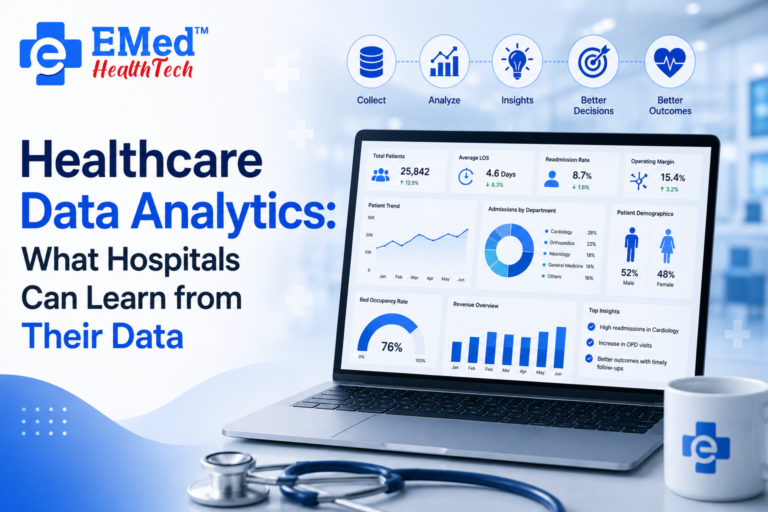
Healthcare
Why Hospitals Are Finally Paying Attention to Their Own Data Every hospital generates a staggering amount of information every single day. Admission records, lab results, billing entries, prescription histories, equipment logs, and patient feedback all pile up quietly in the background. For years, most of that data simply sat there, unused, spread across disconnected systems. […]
Read more
Healthcare
Understanding Electronic Health Records in 2026 Walk into any modern hospital or clinic today and you will notice something missing: the tall metal cabinets stuffed with paper files. In their place is a screen, a login, and a patient history that loads in seconds. That shift did not happen by accident. It happened because healthcare […]
Read more