Posted by
Hasanabbas
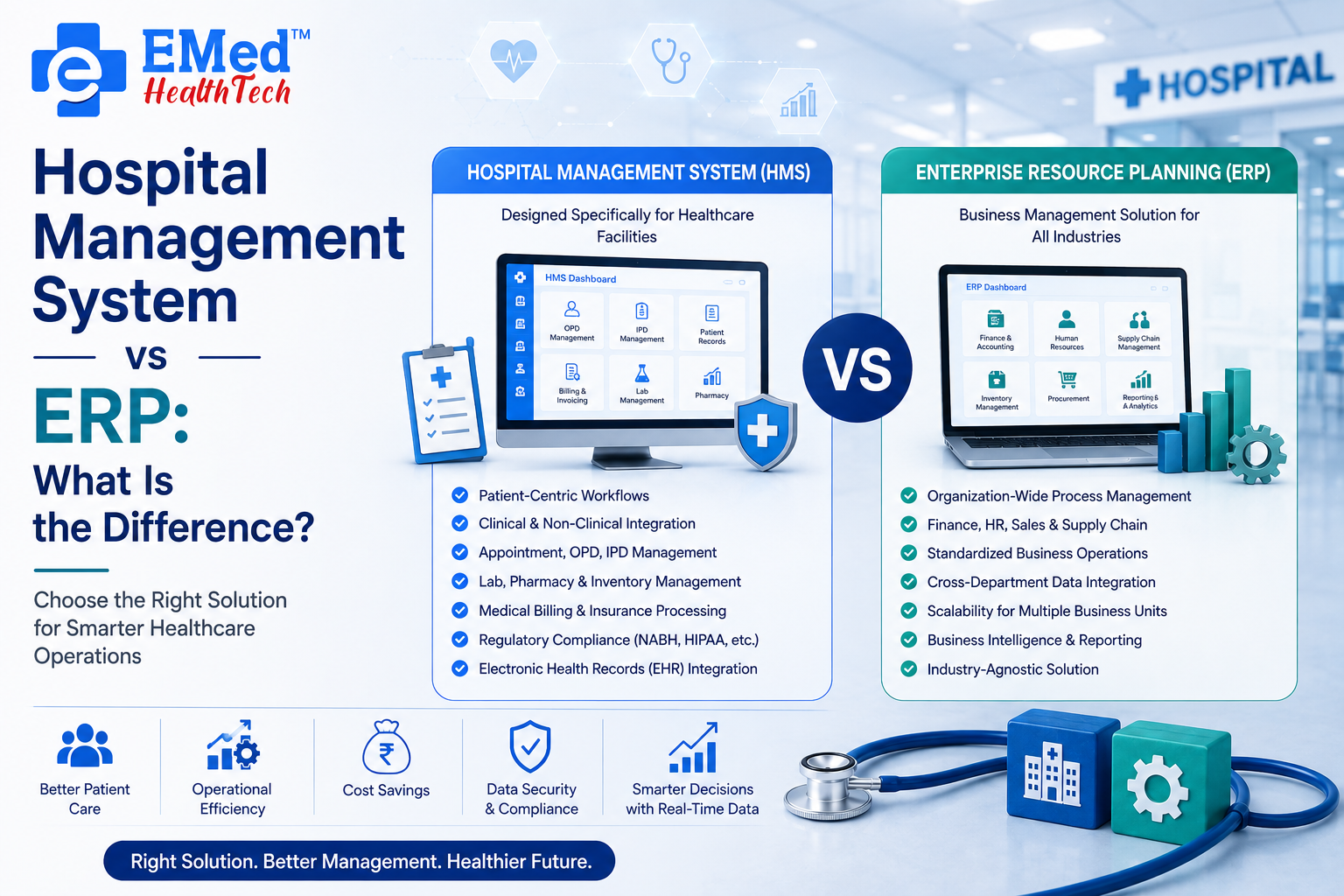 Anyone who has sat through a hospital software demo has probably heard both terms tossed around in the same breath. Vendors talk about hospital management systems, then slip into ERP jargon a minute later, and by the end of the call you are left wondering if these two things are actually the same product wearing different names. They are not. The hospital management system vs ERP question comes up constantly during procurement because hospitals are buying two different kinds of software that solve two different kinds of problems, even though both eventually end up talking to each other inside the same building.
In this guide, we will break down what each system actually does, where their features overlap, and where they genuinely part ways. By the end, you should be able to walk into your next vendor meeting and ask sharper questions instead of nodding along to buzzwords.
A hospital management system is built around patient care. It is the software your front desk uses to register a patient, the screen a doctor pulls up during OPD consultation, and the tool a nurse checks before administering medication on the ward. Every workflow inside an HMS revolves around a patient record, from the moment someone books an appointment to the day they get discharged.
This is why an HMS usually sits close to clinical modules such as electronic health records, lab and radiology reporting, OT scheduling, and nursing documentation. A well built hospital management system does not just store data, it connects departments so a lab result entered in the diagnostics module shows up instantly on a doctor’s screen without anyone re-typing it.
Enterprise resource planning software, or ERP, was never designed exclusively for hospitals. It comes from the manufacturing and retail world, where businesses needed one system to manage inventory, procurement, finance, payroll, and vendor relationships. When hospitals adopted the concept, ERP became the backbone for everything that keeps a healthcare facility running as a business rather than as a clinical service.
A hospital ERP tracks medicine stock levels, raises purchase orders when supplies run low, manages employee attendance and payroll, reconciles accounts, and generates the financial reports that management actually cares about at month end. Think of it as the operational engine sitting behind the scenes while doctors and nurses focus on patients.
The simplest way to understand the difference between HMS and ERP is to remember what each one was built to protect. HMS protects the patient journey. ERP protects the business operation. They frequently share a database, but their purpose is not identical, and that distinction matters a lot when you are budgeting for new hospital software.
HMS focuses on clinical workflows such as registration, consultation, admission, and discharge. ERP focuses on business workflows such as inventory, finance, and human resources. A hospital can technically run patient care with just an HMS, but it would struggle to manage its supply chain or payroll without ERP support.
Doctors, nurses, lab technicians, and front desk staff spend most of their day inside the HMS. Finance teams, procurement officers, HR staff, and store managers live inside the ERP. Administrators typically use both, since they need visibility into patient volumes as well as operating costs.
HMS data is largely clinical: diagnosis codes, prescriptions, vitals, and treatment history. ERP data is largely transactional: purchase orders, invoices, stock ledgers, and payroll records. When these two systems are properly integrated, a hospital gets a single source of truth instead of two departments working off separate spreadsheets.
Looking at hospital management system features side by side with hospital ERP features makes the split even clearer. Neither list is better than the other, they simply serve different audiences inside the same building.
Some hospital software vendors bundle both feature sets into a single platform, which is where the confusion around difference between HMS and ERP usually starts. A platform can absolutely include both, but that does not mean the two functions stop being distinct pieces working toward different goals.
Small clinics and single specialty centers often start with just an HMS because their operational overhead is light and patient management is the priority. Multi department hospitals, diagnostic chains, and hospital groups usually need both, because manual inventory tracking and manual payroll processing become unmanageable once the facility grows past a certain size.
If your team is spending more time chasing stock shortages and reconciling bills than treating patients, that is usually the signal that ERP capability is missing. If your team is drowning in paper prescriptions and duplicate patient records, that points to a gap on the HMS side instead.
The real advantage shows up when HMS and ERP are not treated as two separate purchases but as one connected system. Integrated hospital software lets a nurse’s medication entry automatically deduct from pharmacy stock, lets a discharge summary trigger the final bill without manual entry, and lets management pull a single report that shows patient volume next to operating cost.
This is also where healthcare data analytics becomes genuinely useful, since a connected system gives you clean data from both the clinical and financial side instead of two mismatched datasets that need manual reconciliation before anyone can trust the numbers.
At EMed HealthTech, we build custom healthcare software that lets hospitals choose exactly which HMS and ERP modules they need instead of paying for a rigid, one size fits all package. Whether you need standalone patient management, a full EHR and EMR setup, or a complete hospital operation suite, our team scopes the modules around your existing workflow.
We have delivered healthcare IT projects across 34 plus countries, and every build starts with understanding how your departments actually talk to each other today, so the software we hand over removes friction instead of adding another disconnected screen for your staff to manage.
Hospital management system vs ERP is not really a competition, it is a division of labor. HMS keeps the clinical journey smooth for patients and doctors, while ERP keeps the business side of the hospital financially sound and well stocked. Understanding where each system starts and stops helps you ask better questions during procurement and avoid paying for features you do not actually need. If your hospital is ready to map out the right combination of modules, our team at EMed HealthTech is happy to walk you through it.
No. HMS handles patient care workflows such as registration and treatment records, while ERP handles business operations such as inventory, finance, and payroll for the hospital.
A hospital can run its inventory and finance through ERP alone, but without an HMS it would lack proper patient records, appointment scheduling, and clinical documentation.
Look for inventory and pharmacy stock control, procurement automation, payroll and attendance, financial accounting, and centralized reporting dashboards.
In a well integrated hospital software setup, yes. Sharing data avoids duplicate entry and keeps clinical records aligned with billing and inventory.
Most small clinics start with HMS since patient management is the immediate need, and add ERP capability once inventory and staffing complexity grow.
When treatment records automatically feed into billing, there is no manual re-entry, which removes the most common source of mismatched invoices.
Custom software lets you pick only the modules your hospital actually uses, which usually costs less over time than paying for unused features in a rigid package.
Yes, our team designs connected systems that combine clinical and operational modules, or delivers either one as a standalone solution depending on your requirement.
Hasanabbas

Hospital Management Software
Navigating Healthcare Sectors: Attain Top-Tier Hospital Management System for 2024
Read more
Hospital Management Software
10 Reasons Why You Should Use Hospital Management Software
Read more