EHR vs EMR - Key Differance

What Is an EHR vs EMR? Key Differences Explained for Hospitals

EHR vs EMRIf you run a hospital or you are evaluating health IT vendors, you have likely typed the phrase ehr vs emr difference into Google more than once. The two terms get used interchangeably by vendors, staff, and even some software brochures, and that habit creates real confusion when a hospital is trying to choose a system that will run its wards for the next ten years. This guide breaks down what each term actually means, how they differ in practice, and which one fits a hospital, a clinic, or a diagnostic center in India today.

What Is an EMR in Healthcare?

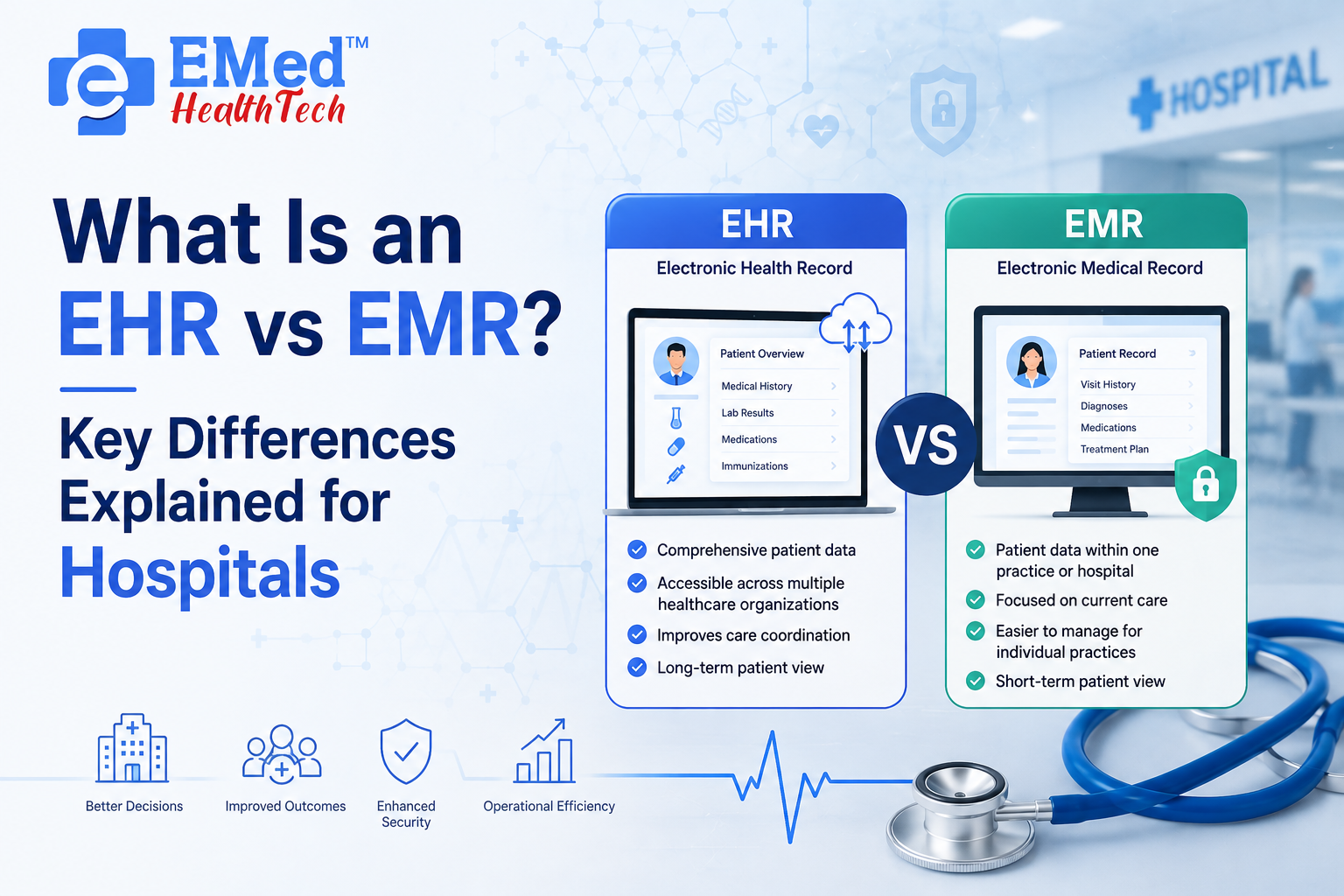
An EMR, or electronic medical record, is a digital version of the paper chart you would find inside a single clinic or a single hospital department. It holds a patient’s diagnosis, treatment notes, prescriptions, and visit history, but that data generally stays inside the four walls of the practice that created it. An EMR is a strong fit for a solo doctor, a small nursing home, or a diagnostic lab that only needs to track its own patients without exchanging data with outside providers.

What Is EHR in Healthcare?

EHR stands for electronic health record, and it is built with a much wider purpose. Rather than sitting inside one clinic, an EHR is designed to travel with the patient. It pulls together lab results, radiology reports, medication history, allergies, and visit summaries from multiple providers into one connected profile. This is exactly why hospitals adopt EHR or EMR software that is built for interoperability rather than a closed, single location record system.

EHR vs EMR Difference: The Core Distinctions

Once you place the two definitions side by side, the ehr emr difference becomes much easier to see. The gap is not really about features on a screen, it is about how far the data is meant to travel and who is allowed to see it.

Scope of Patient Information

An EMR generally holds information tied to one facility. An EHR is built to hold a patient’s complete medical journey, including care received outside the hospital that first created the record.

Interoperability and Data Sharing

This is the biggest difference in day to day hospital operations. EMR data usually cannot move easily between systems. EHR platforms are designed around data exchange standards so that labs, pharmacies, specialists, and even government health programs can read the same record without duplicate data entry.

Who Actually Uses Each System

Small clinics and individual practitioners are usually comfortable with an EMR. Hospitals, multi speciality chains, and diagnostic networks that coordinate care across departments need an EHR, because patient safety depends on every department seeing the same, current information.

Point of ComparisonEMR (Electronic Medical Record)EHR (Electronic Health Record)
Scope of dataLimited to one clinic or hospital visit historyComplete patient health history across providers
Data sharingStays within a single practice, rarely sharedBuilt for interoperability and easy sharing
Primary usersIndividual doctors, small clinicsHospitals, multi speciality chains, labs
Patient accessUsually not accessible to patients directlyPatients can often view records via portals
Best suited forSolo practitioners and small diagnostic setupsHospitals needing ABDM linked, connected care


Electronic Health Record vs Medical Record: Are They the Same Thing?

Patients and even some administrative staff often ask about electronic health record vs medical record as though they are separate categories. A medical record, in its traditional sense, is simply the clinical documentation created during a patient’s care, whether on paper or on a screen. An electronic health record is the digitized, connected version of that documentation, designed to be shared responsibly across the care network rather than locked inside one file room. So a medical record is the content, and an EHR is the modern, connected format that content lives in today.

Why EHR Software Matters for Hospitals in India

Indian hospitals are under growing pressure to digitize records that can be linked with government health programs, insurance providers, and referral networks. A hospital running on disconnected paper files or a basic EMR often struggles with duplicate tests, delayed reports, and billing errors, all of which slow down patient care and increase operating cost.

ABDM and the Push for Connected Records

India’s Ayushman Bharat Digital Mission is accelerating the shift from isolated EMRs toward fully connected EHR systems. Hospitals that plan to participate in ABDM linked care, or simply want a smoother referral process with labs and specialists, need infrastructure that supports proper ABDM integration rather than a closed record system that cannot talk to outside networks.

EMR for Hospitals vs EHR for Hospitals: Which One Do You Need?

If a facility is a single clinic with one or two doctors and no plan to exchange data with outside providers, an EMR can still be sufficient. But once a facility grows into a hospital with multiple departments, an OPD, an inpatient wing, a pharmacy, and a diagnostic lab under one roof, an EHR becomes necessary. Hospitals also benefit from pairing EHR software with a broader hospital management system so that clinical records, billing, bed management, and inventory all run on connected data instead of separate spreadsheets and standalone tools.

Choosing the Right EHR Software in India

When a hospital administrator starts comparing ehr software India options, a few things matter more than the marketing brochure. Look for HIPAA and HL7 aligned architecture, native support for ABDM, role based access control, and the ability to scale from one hospital to a multi location chain without a full rebuild. It also helps to work with a partner who can build the record system around the hospital’s existing workflow instead of forcing staff to adapt to rigid software.

Many hospitals also pair their EHR rollout with healthcare data analytics services so that the connected patient data can be turned into usable insight, covering everything from readmission trends to resource planning. For hospitals that need something built around their exact departments and specialities rather than a generic template, custom healthcare software development is usually the more practical route than trying to force fit an off the shelf product.

Final Thoughts

The short version of the ehr vs emr difference is this. An EMR is a digital chart for one clinic. An EHR is a connected health record built to travel with the patient across labs, specialists, and hospitals. For a growing hospital in India, especially one preparing for ABDM compliance and multi department coordination, EHR software is almost always the right long term investment, while EMR remains a reasonable choice only for very small, single location practices.

Frequently Asked Questions

What is EHR in healthcare in simple terms?

EHR stands for electronic health record. It is a digital, shareable record of a patient’s complete medical history that can move across hospitals, labs, and specialists.

What is the main ehr emr difference for a hospital?

EMR data usually stays inside one facility, while EHR data is designed to be shared across multiple providers, which matters for hospitals that coordinate care between departments.

Is electronic health record vs medical record the same comparison as EHR vs EMR?

Not exactly. A medical record is the clinical content itself, while an EHR is the connected digital format that record is stored and shared in today.

Can a small clinic use an EMR instead of a full EHR system?

Yes. A solo practice or small diagnostic center with no need to exchange data outside the clinic can usually run well on a simple EMR.

Why do hospitals need EHR software instead of EMR software?

Hospitals have multiple departments and often work with outside labs, insurers, and referral networks, so they need EHR software built for that level of data exchange.

Does EHR software in India need to support ABDM?

Most growing hospitals in India benefit from ABDM ready EHR software, since it allows patient records to connect with the national digital health ecosystem.

What features should hospitals look for in EHR software?

Look for interoperability, role based access, HL7 and HIPAA aligned security, ABDM support, and the ability to integrate with billing and lab systems.
EMR vs. EHR Software Development What to Choose for Your Healthcare Business

EMR vs. EHR Software Development: What to Choose for Your Healthcare Business?

Technology makes our lives more convenient, there is no doubt. We can see different tech types being adapted to different aspects of our lives, including healthcare. Some of the most commonly used tech in healthcare are healthcare software. 

Healthcare software refers to computer programs and applications designed for use in the healthcare industry. These software solutions may be custom-made or off-the-shelf products that help manage and optimize various healthcare-related tasks. It helps with patient records management, billing, scheduling, electronic health records (EHR), and other medical and administrative functions.

Since there are many options to choose from, you could be confused when picking one. As a healthcare business, you can make a better choice after reading this article, as we are going to explore two of the most popular options in healthcare software development: EMR and EHR. 

Let us explore the major differences between EMRs, or electronic medical records, and EHRs, or electronic health records. We will also look at the difference in the development process of each of these so you can make an informed decision. 

What is EHR Software? 

Electronic Health Records (EHR) have become a part of the modern healthcare industry. They are also sometimes called electronic patient charts. This is because they do what previously paper charts used to do, only much more efficiently. This software provides real-time access to patient information, including medical conditions, lab records, and prescriptions. With this software, doctors and medical professionals can quickly access medical data. 

How is an EHR System Used? 

An EHR is a versatile software that finds immense applications in the medical world. Here are some ways your healthcare business can use the EHR system

  1. Better decision-making and treatment can be given to patients. It also provides better care to patients as data can be accessed quickly, leading to better outcomes as well. 
  2. Patients have better access to their medical information, increasing patient engagement and self-management. 
  3. EHR leads to better collaboration between departments as well as healthcare services, as medical history can be accessed from anywhere. 
  4. EHRs streamline administrative processes, such as billing and appointment scheduling, making healthcare operations more efficient.
  5. It can contribute to medical research as huge amounts of data are available under a single system. It also leads to the betterment of medical services as a whole.
  6. EHRs assist healthcare organizations in meeting regulatory requirements and reporting, ensuring compliance with healthcare standards and laws.
  7. EHRs are great for legal documentation of medical procedures, diagnoses, and treatments. It covers healthcare providers in legal matters.

Why Should a Healthcare Business Use EHR Softwares? 

EHRs offer numerous advantages for healthcare providers, patients, and clinics. Here is a look at why you should consider it, too: 

Better outcomes:

EHRs offer faster access to patient information, leading to higher-quality care. Doctors can provide better treatment thanks to the data available, which leads to informed decisions. 

All data under one roof:

EHRs maintain current patient records. This way, doctors can get the latest updates and access all available information, even if the patient has consulted multiple healthcare services. 

Integration:

EHRs seamlessly integrate with other healthcare systems in the facility. Be it billing software or pharmacy software, there is better connectedness and coordination. 

Enhanced efficiency:

EHRs save time for healthcare providers. This means the time spent on appointments and outpatient visits is much lower. 

Security:

Data security is a priority for EHR. You have to stick to regulations like HIPAA, ensure patient data protection, and maintain stringent security standards. 

In short, electronic health records (EHRs) are a revolution in itself. But is it the best tool for your healthcare business? Read about EMR and decide for yourself. 

What is EMR Software in Healthcare?

Electronic medical records (EMR) is a cutting-edge concept that has significantly transformed healthcare management. Unlike traditional paper health records, EMRs make patient information entirely digital. An EMR makes it efficient to access them, store them securely, and manage them easily. They give all the information regarding it under a single interface. 

How is an EHR System Used? 

EMR systems serve as the central hub for various clinical activities in healthcare settings, offering a range of features and functionalities:

Patient Information Management:

EHRs store vital patient data, including treatment history and diagnoses. It provides better access to medical records.

Appointment Scheduling:

EHRs streamline appointment management. It makes scheduling appointments and patient flow a breeze. 

Data Sharing:

There is better data sharing among healthcare team members, promoting up-to-date information access.

New Patient Integration:

Onboarding for new patients is no longer a nightmare. There is a complete and accurate record for better treatment. 

Clinical Documentation:

Keep a tab of everything that’s happening with clinical data recording and logging. No more heavy paper records and manual entry.

Regulatory Compliance:

Stay compliant with evolving regulations and adherence to industry standards and guidelines.

Why Should a Healthcare Business Invest in EMR Softwares? 

Electronic Medical Records (EMRs) offer plenty of advantages for healthcare professionals, organizations, as well as patients. Here is a quick look at them. 

Save space:

With this software, there is no need for physical paper record storage. As patients’ volumes rise, this becomes a lifesaver. 

User-Friendly:

You don’t have to rummage around looking for files as they are all available under the click of a button in a user-friendly interface. 

Streamlined Organisation:

Manual record keeping is more expensive. Make your staff more resourceful and operations better with electronic record keeping. 

Enhanced Prescription Safety:

When it comes to medication, EMRs can help patients get the best medicine without the hassles. Any interactions with other medications will also be notified. 

Robust Data Security:

EMRs are all about keeping data safer, sticking to regulations, and maintaining a hierarchy of authorized access.

Better Communication:

EMRs help healthcare professionals communicate and coordinate better, leading to better outcomes. 

EMRs offer a secure, efficient, and collaborative approach to managing patient information. 

They have become indispensable tools in the medical industry. 

How Does the Software Development Process Differ? 

EMR and EHR software development processes have major differences. Their functionalities and applications make them entirely different processes. 

When it comes to EMR Software Development: 

  1. The focus is on clinical functionality, which can be tailored to each healthcare business. The focus is on better tracking of patient records and treatment history.
  2. It incorporates remote patient monitoring tools so that doctors can monitor remote vital signs and provide treatment on time.
  3. EMR software integrates advanced technologies like AI, data analysis, and blockchain, enhancing data utilization for research and analysis.
  4. There is a higher need to stick to data quality standards, thanks to a dynamic regulatory environment. 
  5. Internet of Medical Things (IoMT) devices and wearables are a part of this system. It helps improve patient safety by monitoring vital signs. 

On the Other hand, EHR Software Development involves: 

  1. It is more than just clinical functions, it creates a complete healthcare ecosystem. There are a lot of aspects in focus, not just data.
  2. Patients and physicians can better keep an eye on habits such as diet, exercise, and sleep. This is a more holistic approach. 
  3. EHRs are all about data exchange between healthcare professionals and facilities, enhancing care coordination. Interoperability is in focus here. 
  4. Robust data security is a priority. Developers have to ensure they protect patient privacy and maintain data integrity.

Developers focus on different aspects to emphasize EHR and EMR. Depending on your needs, these can be customized to include more aspects for better efficiency. 

EHR vs. EMR Software: Comparison

In short, while EMRs and EHRs serve as digital records for healthcare information, EHRs are more comprehensive and versatile.  EMRs, on the other hand, are typically limited to the needs of a specific healthcare facility. 

Depending upon the needs of your healthcare business, you can make an informed choice. 

Choose EMR or EHR Software. Our Health Tech Experts Can Help You

In the EHR vs. EMR debate, both serve as foundations for the future of medical practice. Both enhance data collection and processing. The choice ultimately falls on you. Before you choose, understand the difference between EHR and EMR, the features they offer, and how they align with your business goals. Also, keep a keen eye for regulations. 

The other major choice here is to pick the right developer. An EHR/EMR software development company should be able to offer you the option to customize. Also, look for a company with EHR/EMR software developers who have ample experience to their name. 

As an experienced medical software development company, EMed Healthtech builds user-centric EMR/EHR applications. We leverage our expertise and the latest best practices to help you create successful healthcare products.

Interested in learning more about our EHR/EMR software development or need a quote for your next project? Get in touch with us!