Posted by
Hasanabbas
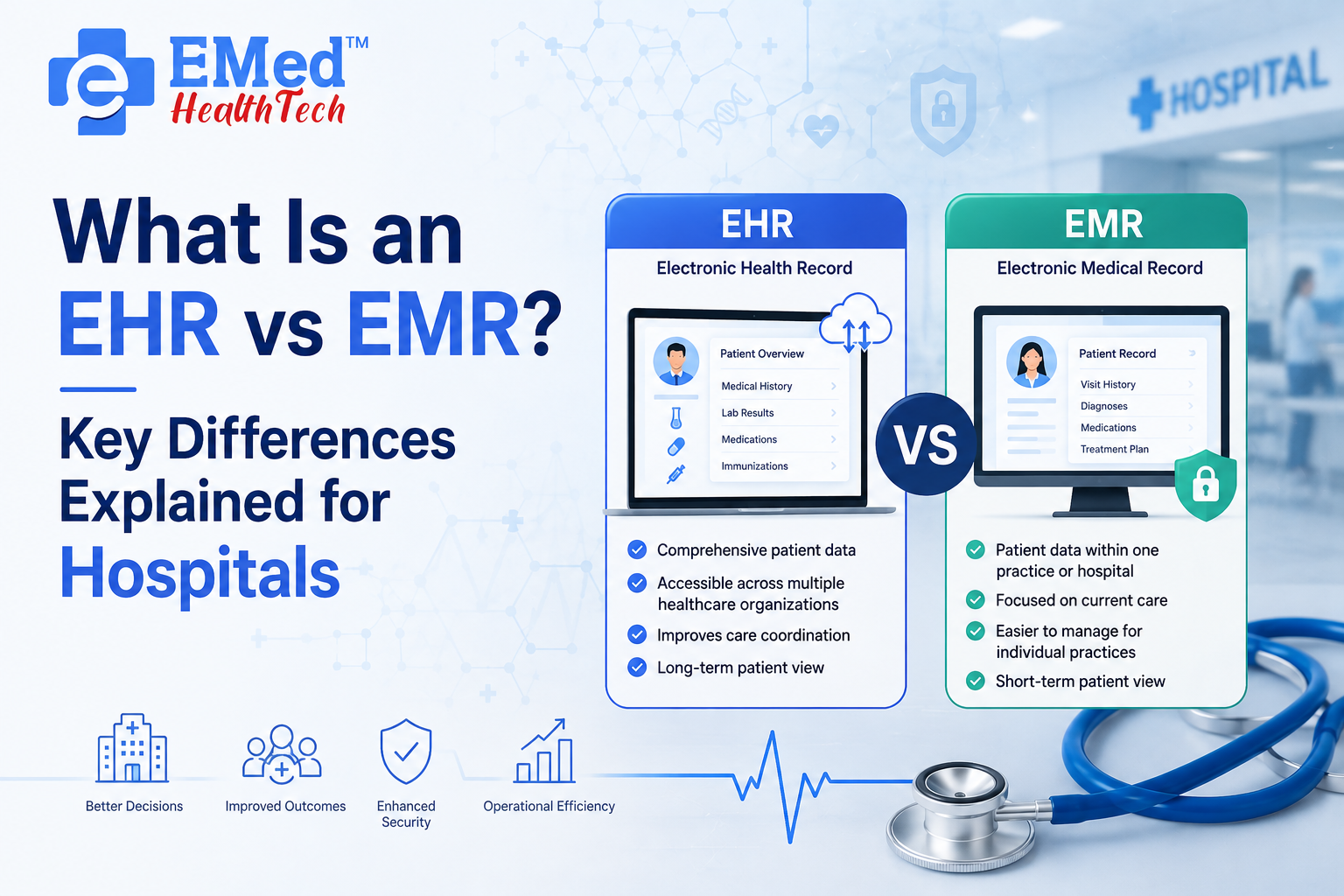 If you run a hospital or you are evaluating health IT vendors, you have likely typed the phrase ehr vs emr difference into Google more than once. The two terms get used interchangeably by vendors, staff, and even some software brochures, and that habit creates real confusion when a hospital is trying to choose a system that will run its wards for the next ten years. This guide breaks down what each term actually means, how they differ in practice, and which one fits a hospital, a clinic, or a diagnostic center in India today.
An EMR, or electronic medical record, is a digital version of the paper chart you would find inside a single clinic or a single hospital department. It holds a patient’s diagnosis, treatment notes, prescriptions, and visit history, but that data generally stays inside the four walls of the practice that created it. An EMR is a strong fit for a solo doctor, a small nursing home, or a diagnostic lab that only needs to track its own patients without exchanging data with outside providers.
EHR stands for electronic health record, and it is built with a much wider purpose. Rather than sitting inside one clinic, an EHR is designed to travel with the patient. It pulls together lab results, radiology reports, medication history, allergies, and visit summaries from multiple providers into one connected profile. This is exactly why hospitals adopt EHR or EMR software that is built for interoperability rather than a closed, single location record system.
Once you place the two definitions side by side, the ehr emr difference becomes much easier to see. The gap is not really about features on a screen, it is about how far the data is meant to travel and who is allowed to see it.
An EMR generally holds information tied to one facility. An EHR is built to hold a patient’s complete medical journey, including care received outside the hospital that first created the record.
This is the biggest difference in day to day hospital operations. EMR data usually cannot move easily between systems. EHR platforms are designed around data exchange standards so that labs, pharmacies, specialists, and even government health programs can read the same record without duplicate data entry.
Small clinics and individual practitioners are usually comfortable with an EMR. Hospitals, multi speciality chains, and diagnostic networks that coordinate care across departments need an EHR, because patient safety depends on every department seeing the same, current information.
| Point of Comparison | EMR (Electronic Medical Record) | EHR (Electronic Health Record) |
| Scope of data | Limited to one clinic or hospital visit history | Complete patient health history across providers |
| Data sharing | Stays within a single practice, rarely shared | Built for interoperability and easy sharing |
| Primary users | Individual doctors, small clinics | Hospitals, multi speciality chains, labs |
| Patient access | Usually not accessible to patients directly | Patients can often view records via portals |
| Best suited for | Solo practitioners and small diagnostic setups | Hospitals needing ABDM linked, connected care |
Patients and even some administrative staff often ask about electronic health record vs medical record as though they are separate categories. A medical record, in its traditional sense, is simply the clinical documentation created during a patient’s care, whether on paper or on a screen. An electronic health record is the digitized, connected version of that documentation, designed to be shared responsibly across the care network rather than locked inside one file room. So a medical record is the content, and an EHR is the modern, connected format that content lives in today.
Indian hospitals are under growing pressure to digitize records that can be linked with government health programs, insurance providers, and referral networks. A hospital running on disconnected paper files or a basic EMR often struggles with duplicate tests, delayed reports, and billing errors, all of which slow down patient care and increase operating cost.
India’s Ayushman Bharat Digital Mission is accelerating the shift from isolated EMRs toward fully connected EHR systems. Hospitals that plan to participate in ABDM linked care, or simply want a smoother referral process with labs and specialists, need infrastructure that supports proper ABDM integration rather than a closed record system that cannot talk to outside networks.
If a facility is a single clinic with one or two doctors and no plan to exchange data with outside providers, an EMR can still be sufficient. But once a facility grows into a hospital with multiple departments, an OPD, an inpatient wing, a pharmacy, and a diagnostic lab under one roof, an EHR becomes necessary. Hospitals also benefit from pairing EHR software with a broader hospital management system so that clinical records, billing, bed management, and inventory all run on connected data instead of separate spreadsheets and standalone tools.
When a hospital administrator starts comparing ehr software India options, a few things matter more than the marketing brochure. Look for HIPAA and HL7 aligned architecture, native support for ABDM, role based access control, and the ability to scale from one hospital to a multi location chain without a full rebuild. It also helps to work with a partner who can build the record system around the hospital’s existing workflow instead of forcing staff to adapt to rigid software.
Many hospitals also pair their EHR rollout with healthcare data analytics services so that the connected patient data can be turned into usable insight, covering everything from readmission trends to resource planning. For hospitals that need something built around their exact departments and specialities rather than a generic template, custom healthcare software development is usually the more practical route than trying to force fit an off the shelf product.
The short version of the ehr vs emr difference is this. An EMR is a digital chart for one clinic. An EHR is a connected health record built to travel with the patient across labs, specialists, and hospitals. For a growing hospital in India, especially one preparing for ABDM compliance and multi department coordination, EHR software is almost always the right long term investment, while EMR remains a reasonable choice only for very small, single location practices.
EHR stands for electronic health record. It is a digital, shareable record of a patient’s complete medical history that can move across hospitals, labs, and specialists.
EMR data usually stays inside one facility, while EHR data is designed to be shared across multiple providers, which matters for hospitals that coordinate care between departments.
Not exactly. A medical record is the clinical content itself, while an EHR is the connected digital format that record is stored and shared in today.
Yes. A solo practice or small diagnostic center with no need to exchange data outside the clinic can usually run well on a simple EMR.
Hospitals have multiple departments and often work with outside labs, insurers, and referral networks, so they need EHR software built for that level of data exchange.
Most growing hospitals in India benefit from ABDM ready EHR software, since it allows patient records to connect with the national digital health ecosystem.
Look for interoperability, role based access, HL7 and HIPAA aligned security, ABDM support, and the ability to integrate with billing and lab systems.
Hasanabbas
EMR vs. EHR Software
EMR vs. EHR Software Development: What to Choose for Your Healthcare Business?
Read more